
POM-C, PEEK, or PTFE? The Ultimate Engineering Plastics Guide for Precision CNC Machining
Technical Blog Article & SEO Guide for Ruichenxing Industry Website
Target URL / Slug | /resources/engineering-plastics-cnc-machining-guide/ |
Meta Title | POM-C, PEEK, or PTFE? Engineering Plastics Precision CNC Machining Guide |
Meta Description | Compare POM-C, PEEK, PTFE, ABS & Nylon for CNC machining. Learn about material selection, stress-relief annealing, bead blasting finish & ±0.005mm tolerances. |
Focus Keywords | Engineering Plastics CNC Machining, POM-C vs PEEK, Delrin Machining, Plastic Bead Blasting, Precision Plastic Parts, ABS CNC Machining |
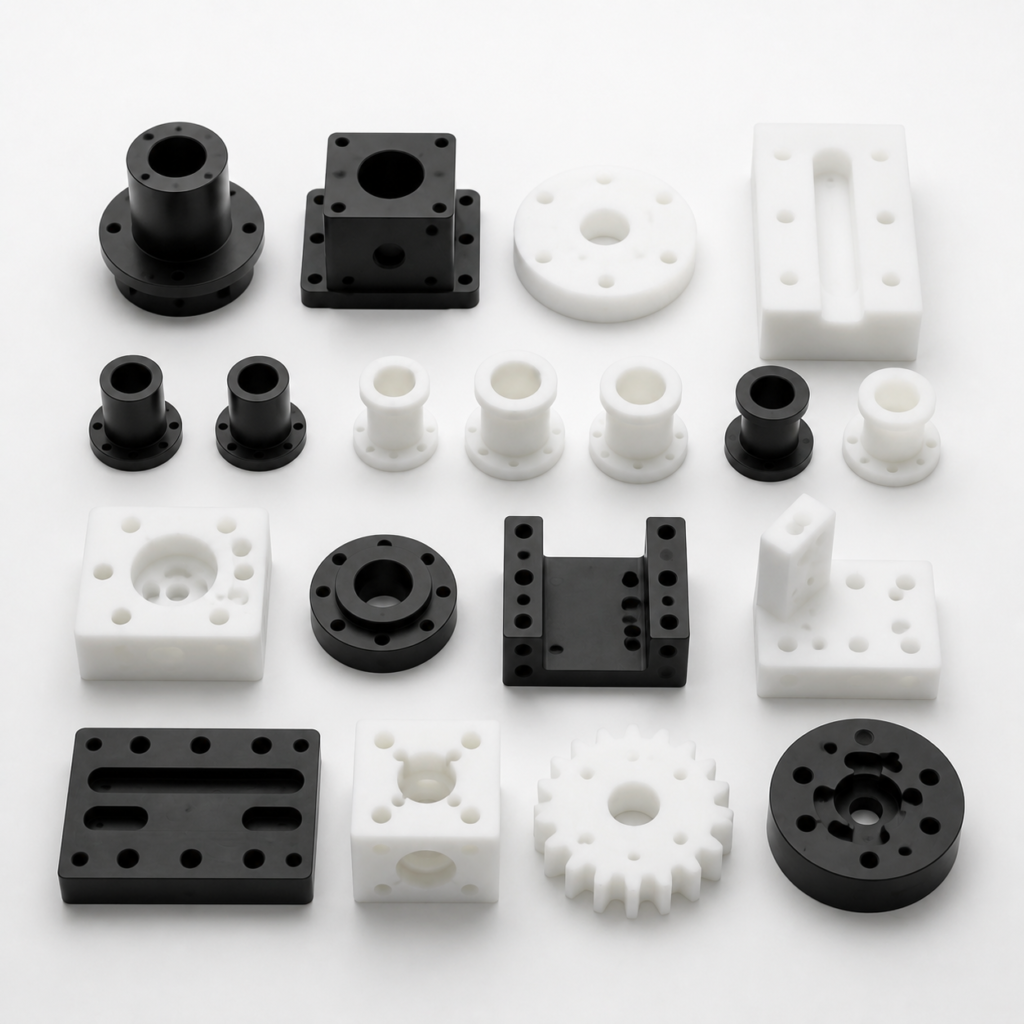
Figure 1: High-precision CNC milled & turned POM-C (Delrin/Acetal) structural components.
Introduction
In modern industrial engineering, high-performance engineering plastics are rapidly replacing metals across robotics, medical devices, automotive systems, and advanced electronics. Offering significant weight reduction, superior corrosion resistance, self-lubrication, and electrical insulation, engineering plastics are ideal for complex and mission-critical components.
However, selecting the right polymer and mastering its machining nuances are crucial to preventing dimensional instability, burrs, and thermal deformation. In this technical guide, our engineering team breaks down the most widely used CNC engineering plastics, key machining techniques, and optimal surface finishes.
1.Comparing Top CNC Engineering Plastics: Properties & Best Applications
Material | Key Advantages | Typical Applications | Cost Tier |
POM-C (Acetal / Delrin) | High rigidity, low friction, excellent dimensional stability, easy to machine. | Gears, bushings, valve housings, precision sliding fixtures, vent cups. | ★☆☆☆☆ |
PEEK (Polyetheretherketone) | Continuous heat resistance up to 250°C+, extreme chemical inertness, high strength. | Medical implants, aerospace parts, semiconductor wafer carriers. | ★★★★★ |
PTFE (Teflon) | Outstanding chemical inertness, near-zero friction, wide operating temperature range. | Seals, chemical valve seats, high-frequency electrical insulators. | ★★★☆☆ |
ABS (Engineering Grade) | High impact strength, excellent machinability, great surface finish, versatile. | Electronic enclosures, automotive interior brackets, functional covers. | ★☆☆☆☆ |
Nylon (PA66 / PA6) | High tensile strength, high wear resistance, good vibration and impact damping. | Rollers, pulleys, wear pads, structural brackets and gears. | ★★☆☆☆ |
UHMW-PE | Extreme impact resistance, self-lubricating, zero water absorption. | Guide rails, wear strips, conveyor components, star wheels. | ★★☆☆☆ |
2.Key Challenges in Precision Plastic Machining & Our Solutions
Machining plastics differs fundamentally from metal cutting due to lower thermal conductivity and higher thermal expansion coefficients. Without proper tooling and process controls, parts suffer from warping, melted edges, or out-of-tolerance dimensions.
- Controlling Thermal Expansion & Tool Heat
Plastics soften and deform quickly if cutting heat builds up in the cut zone.
- Our Solution: We utilize dedicated polished-flute carbide cutters with large positive rake angles and sharp cutting edges. Continuous high-pressure air blast is used for active chip evacuation and cooling, avoiding chemical contamination from heavy flood coolants.
- Relieving Internal Stress (Preventing Post-Machining Warpage)
Extruded thick plastic stock inherently carries internal residual stresses. When deep pockets or asymmetrical contours are machined, these stresses release and lead to part twisting over time.
- Our Solution: For tight-tolerance parts (e.g., ±0.01 mm), we implement intermediate stress-relief annealing cycles between roughing and finishing passes to ensure long-term dimensional stability.
- Burr Removal & Micro-Feature Quality
Softer polymers (such as PTFE and unreinforced Nylon) tend to smear and form flexible burrs rather than breaking cleanly into chips.
- Our Solution: Every critical bore, counterbore, and thread is inspected under high-magnification Stereo Microscopes and deburred via cryogenic deflashing or manual micro-scalpel finishing.
- Workshop Video: Real-Time High-Speed Plastic CNC Machining
See our high-speed CNC milling center in action machining engineering plastic components with optimized tool paths and continuous air-cooling chip evacuation:
Figure 2: In-house live video demonstration: Precision CNC milling of engineering plastic components at Ruichenxing factory.
▶ Video Embed Information for Website Publishing: • Source File: 加工塑料视频14.mp4 (High-speed CNC milling with polished tooling) |
3.Surface Finishing for Engineering Plastics: Fine Bead Blasting & Polishing
While CNC machined plastics come off the machine with a clean milled surface (Ra 1.6–3.2 μm), specialized applications require dedicated cosmetic and functional surface treatments:
- Fine Bead Blasting (Micro-Sandblasting): Creates an ultra-uniform, non-reflective matte finish that completely eliminates CNC tool paths and provides superior aesthetic tactile feel and grip (ideal for black ABS, POM-C, and PEEK structural brackets).
- Vapor Polishing / Optical Finishing: Restores optical transparency and scratch-free clarity for transparent polymers such as Acrylic (PMMA) and Polycarbonate (PC).
- Ultrasonic Cleaning: Ensures zero residual coolant, dust, or micro-chips remain in tapped threads and internal blind channels before cleanroom packaging.
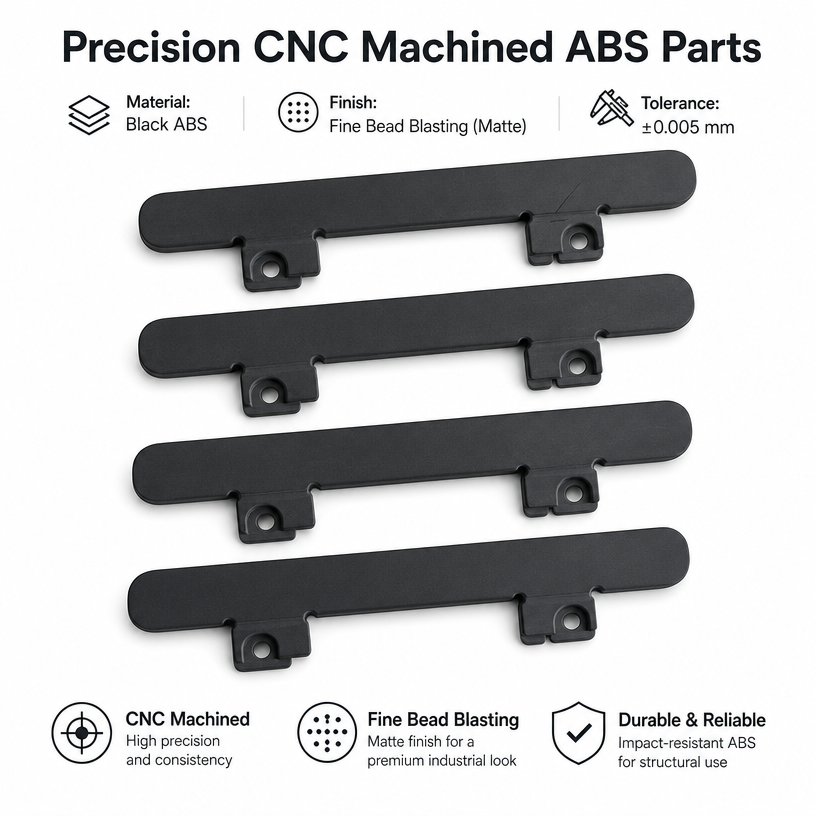
igure 3: Custom CNC machined black ABS parts with fine bead-blasted matte finish and precision counterbores.
4.Quality Assurance & Inspection (Down to ±0.005 mm)
To ensure that all plastic components satisfy stringent aerospace, robotics, and medical specifications, our quality control lab operates in a temperature-controlled environment and utilizes:
- CMM (Coordinate Measuring Machine): For precise 3D geometric dimensioning, true position, perpendicularity, and complex contours.
- AI-Vision Instant Measuring System: Enables automated, rapid multi-dimension batch verification within 2 seconds for high-volume zero-defect delivery.
- Swiss TRIMOS Digital Height Gauge: Provides sub-micron precision for step heights, thicknesses, and hole centerlines.
- Stereo Microscope: For micro-burr inspection, thread tooth profile verification, and surface integrity audits.
- Certified Compliance: CE and RoHS certified. Full inspection documentation (FAI First Article Inspection, OQC Reports, Material Test Certificates) is provided with every shipment.
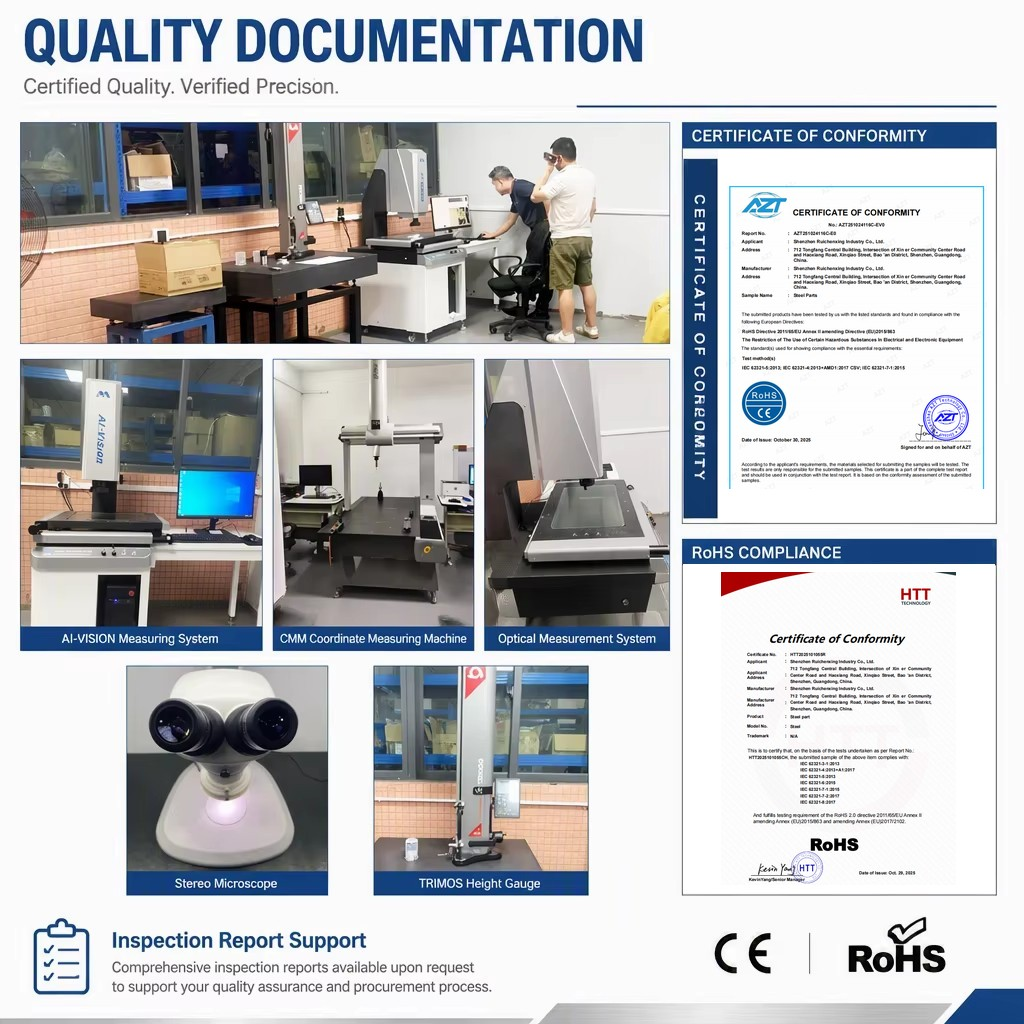
Figure 4: Ruichenxing in-house quality documentation and inspection instruments (CMM, AI-Vision, TRIMOS, Microscope, CE & RoHS).
Ready to Start Your Precision Plastic CNC Project? From rapid prototypes in 3–5 days to high-volume production of 50,000+ parts. Upload your 2D/3D CAD files (STEP, IGES, PDF) for a free 24-hour DFM review and instant quote. |